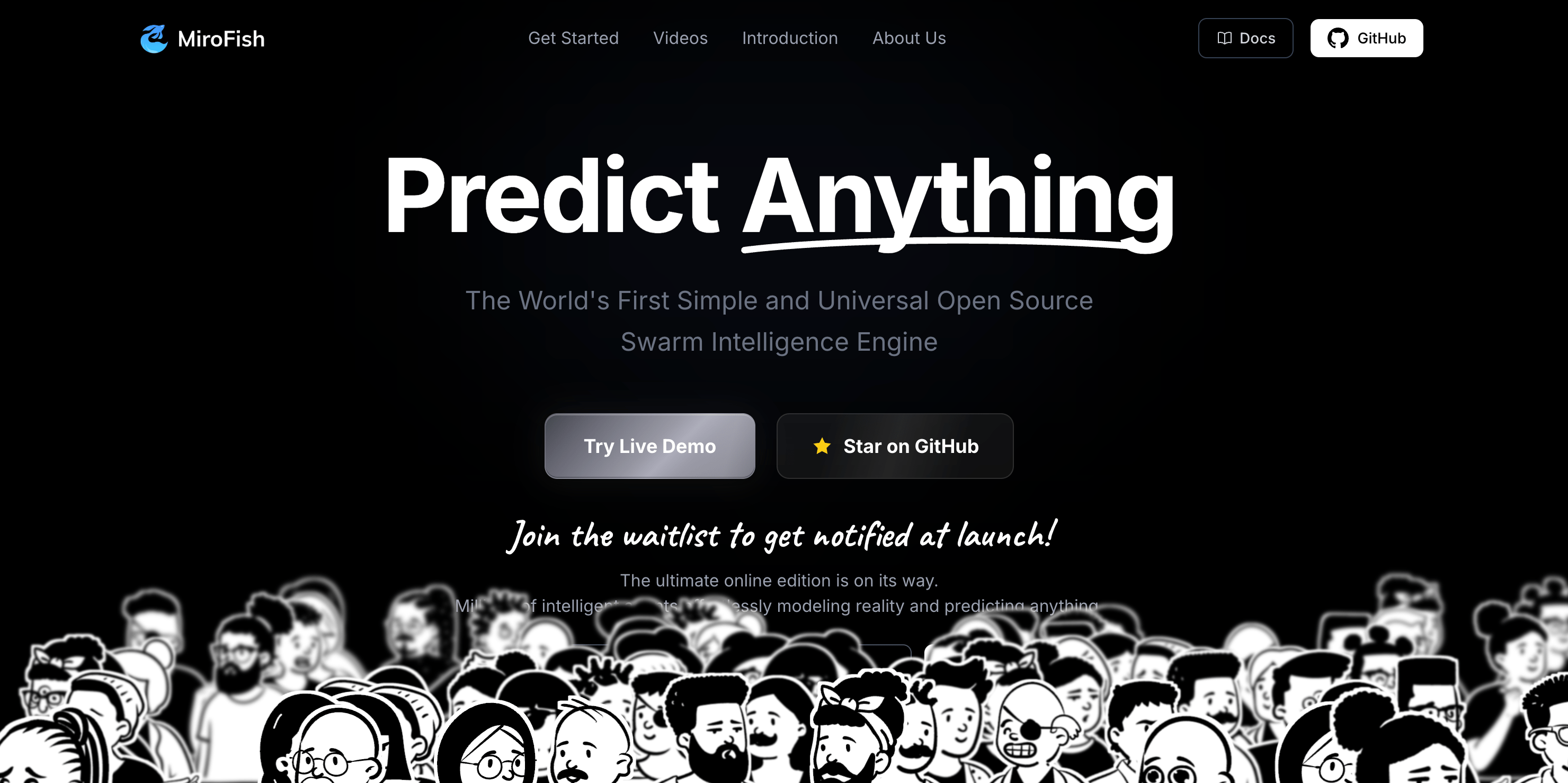
In a world drowning in data but starved for reliable predictions, traditional machine learning models often fail to capture the emergent complexity of real-world systems. MiroFish offers a paradigm shift: instead of training monolithic neural networks, it orchestrates decentralized swarms of simple agents that collectively solve prediction problems through emergent intelligence. This open-source engine brings the power of collective computation to developers, researchers, and businesses seeking robust forecasting capabilities without the computational overhead of traditional AI approaches.
MiroFish implements a novel approach to prediction by modeling problems as swarm intelligence systems. Inspired by natural phenomena like bird flocking, fish schooling, and ant colony optimization, the engine coordinates thousands of simple virtual agents that explore solution spaces collaboratively. Unlike traditional predictive models that require massive labeled datasets and extensive training, MiroFish's agents evolve their behavior through local interactions, creating emergent patterns that accurately forecast outcomes across financial markets, epidemiological trends, social dynamics, and complex system behaviors. The platform's universality stems from its abstract agent architecture—developers define agent behaviors, environmental rules, and fitness functions, while MiroFish handles the emergent computation.
Key Features
- Universal Prediction Framework: MiroFish abstracts prediction problems into swarm intelligence simulations, allowing the same core engine to tackle forecasting challenges across finance, epidemiology, logistics, and social dynamics. Developers define agent behaviors and environmental constraints, while the system handles emergent computation and pattern recognition.
- Decentralized Collective Intelligence: The engine coordinates thousands of simple virtual agents that make local decisions based on limited information, creating sophisticated global predictions through emergent behavior. This approach mirrors natural systems where simple rules generate complex outcomes, providing robustness against noisy data and unexpected system changes.
- Visual Simulation Environment: Real-time visualization tools let users observe swarm dynamics as predictions emerge, offering unprecedented transparency into the prediction process. Unlike black-box neural networks, MiroFish's visual interface shows exactly how collective behaviors evolve toward accurate forecasts.
- Extensible Agent Architecture: Developers can implement custom agent behaviors using Python or JavaScript, extending the system's capabilities to domain-specific problems. The modular design supports everything from financial trading agents to epidemiological models and supply chain optimizers.
- Docker Container Deployment: Pre-configured Docker containers simplify deployment across development, testing, and production environments, ensuring consistent behavior regardless of underlying infrastructure. This containerized approach enables seamless scaling from local experimentation to cloud-based production systems.
Get Started
Getting started with MiroFish requires basic familiarity with Python or JavaScript and container technologies. The project provides comprehensive documentation on GitHub, including installation guides, example simulations, and API references. Begin by cloning the repository and running the Docker container, then explore the example simulations covering financial forecasting and epidemiological modeling. The learning curve is moderate for developers with experience in simulation or agent-based modeling, while newcomers can start with the pre-built examples and modify agent behaviors incrementally. Active community support is available through Discord, GitHub discussions, and Chinese-language QQ groups, offering assistance for both technical implementation and theoretical questions about swarm intelligence applications.
Beyond traditional forecasting applications, MiroFish enables novel approaches to complex system analysis. Researchers can model social contagion processes, economists can simulate market microstructure, and operations teams can optimize logistics networks through emergent agent behaviors. The platform's strength lies in its ability to capture nonlinear relationships and tipping points that elude traditional statistical models—making it particularly valuable for predicting rare events, regime changes, and complex system transitions. As an open-source project, MiroFish benefits from continuous community contributions, with new agent types, visualization tools, and optimization algorithms regularly added to the ecosystem. While not a replacement for all machine learning approaches, it offers a complementary paradigm particularly suited to problems where emergent complexity, adaptability, and interpretability matter more than sheer predictive accuracy on clean, structured datasets.